Life Chances Fund evaluation
Between 2017 and 2025, we served as the UK Government's learning and evaluation partner for the Life Chances Fund (LCF). Through a programme of longitudinal, mixed-methods research, we examined how social outcomes partnerships work in practice, what distinguishes them from conventional approaches to public service commissioning, and the conditions under which they can improve social outcomes.
What was the Life Chances Fund?
Launched by the UK Government in 2016, the Life Chances Fund was a £70 million programme designed to support people facing significant barriers to leading happy and productive lives, while growing the number and scale of social outcomes partnerships (SOPs), also known as social impact bonds (SIBs), commissioned at the local level.
The Fund ran until 2025 and supported 29 projects across England, spanning policy areas including children's social care, health and wellbeing, employment and training, education, criminal justice and homelessness. It was funded by the Department for Culture, Media and Sport and administered by the National Lottery Community Fund on behalf of the UK Government.
Unlike conventional fee-for-service contracts, which typically pay providers for delivering specified activities, social outcomes partnerships link payments to the achievement of agreed social outcomes. They bring together commissioners, service providers and, often, social investors in arrangements intended to encourage collaboration, flexibility and a shared focus on results.
At the time of its launch, the Life Chances Fund was the largest outcomes fund in the world. Its scale, diversity and duration offered a unique opportunity to investigate whether these arrangements could support more adaptive, preventative and person-centred public services, particularly when responding to complex social problems.
GO Lab's Role
As the Life Chances Fund's learning and evaluation partner, our role was to generate independent evidence about whether, when and how social outcomes partnerships offer a better model for commissioning social programmes than more conventional approaches.
Rather than focusing exclusively on whether projects achieved their contracted outcomes, we sought to understand the mechanisms through which the social outcomes partnership model might influence how public services are organised, managed and delivered.
Our evaluation combined portfolio-wide longitudinal research with in-depth studies of individual projects and comparative research across different policy areas. We examined how contractual arrangements, financial incentives, performance management and relationships between organisations shaped service delivery, and how these dynamics evolved over time.
This included longitudinal evaluations of the Kirklees Better Outcomes Partnership and the Mental Health and Employment Partnership, which explored how outcomes-based commissioning influenced the delivery of person-centred support and employment services. We also undertook comparative research across seven Children's Social Care projects, examining the rationale for adopting social impact bonds to support children in or on the edge of care, alongside project design, procurement and economic considerations.
Across these different strands of research, we investigated not only whether outcomes-based commissioning could make a difference, but why, how and in what circumstances. This was particularly important given the diversity of projects supported by the Fund and the challenges of isolating the effects of commissioning arrangements from those of the services themselves.
Alongside our evaluation activities, we worked closely with government and delivery partners to translate emerging evidence into practical learning. Through research publications, open-access data, guidance, training and peer learning opportunities, we sought to ensure that insights from the evaluation could inform decisions throughout the life of the Fund, rather than only after its completion.
What did we learn?
The Life Chances Fund evaluation has contributed to a more nuanced understanding of the potential of social outcomes partnerships as tools for public service reform.
Our research found that well-designed and effectively managed partnerships can support improved social outcomes through mechanisms including greater flexibility for person-centred support, stronger performance management, structured collaboration between organisations and proactive market stewardship.
These findings challenge a narrow understanding of outcomes-based commissioning as primarily a mechanism for transferring financial risk away from government. Instead, they point to its potential to reshape how public services are delivered, creating the conditions for organisations to adapt their approaches, use data to inform decisions and remain accountable for achieving meaningful outcomes.
The evaluation also highlighted the importance of balancing flexibility with accountability. Our longitudinal research into the Kirklees Better Outcomes Partnership, for example, showed how outcomes-based contracting combined with a person-centred, asset-based support model could deliver earlier and more sustained progress in employment and reduced benefit reliance. Compared with conventional service provision, the partnership achieved improved outcomes at a lower per-person cost.
Across the evaluation, approaches such as formal-relational contracting, data-driven iterative learning and investment in local capacity emerged as important mechanisms for supporting more responsive public services. These insights extend beyond social outcomes partnerships themselves, raising broader questions about how governments can design commissioning arrangements that support collaboration, adaptation and continuous improvement.
Impact
Our evaluation generated one of the most extensive bodies of evidence on outcomes-based cross-sector partnerships, informing public service reform and contributing to policy and practice in the UK and internationally.
A defining feature of the programme was its commitment to transparency and learning. Through our INDIGO dataset, granular outcomes achievement data for all 29 projects was made publicly available, including during live delivery. This enabled researchers, policymakers and practitioners to explore project performance alongside contextual evidence about implementation.
The evaluation also informed wider policy discussions about the future of public service commissioning. GO Lab contributed evidence and learning to government departments, parliamentary discussions and cross-government conversations about public service reform. More recently, insights from the Life Chances Fund have informed the development of the UK Government's £500 million Better Futures Fund, as well as work with the Scottish Government to explore the use of outcomes-based partnerships in public service delivery.
Beyond its contribution to policy, the programme helped strengthen the capacity of commissioners and practitioners to design and manage outcomes-based partnerships. Through practical guidance, training, peer learning and our open-access Knowledge Hub, we connected evidence with the experiences of those developing and delivering services, while supporting a growing international community of practice.
This project concluded in March 2026.
Publications
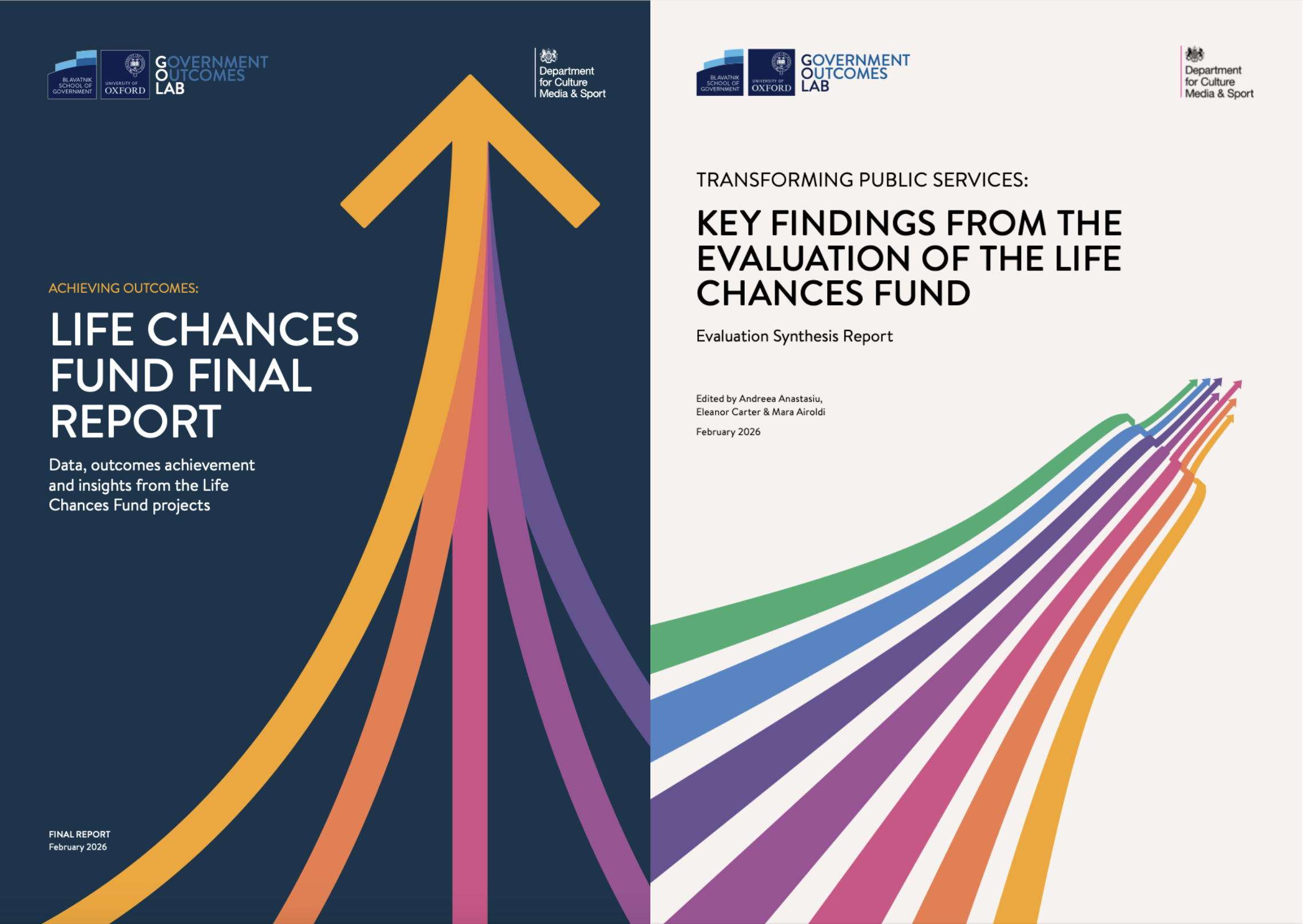
Final reports
Achieving Outcomes: Life Chances Fund Final Report covers all 29 projects that successfully received funding from the Life Chances Fund. It is a project-level evaluation, which studies projects’ characteristics and performance across the portfolio focusing on outcome achievements and payments.
Transforming Public Services: Key findings from the evaluation of the Life Chances Fund Synthesis Report synthesises the extensive evidence generated throughout the evaluation. It provides an overview of the Life Chances Fund, an analysis of the projects supported by the Fund, and synthesises the main findings from the different strands of the evaluation. These findings are structured around the four original research questions and are complemented by broader reflections and lessons drawn from the evaluation experience.
Evaluation of the social outcomes partnership mechanism
The first report focused on capturing insights from the early stages of project mobilisation. Following the onset of Covid-19 restrictions in March 2020, the report also captured the impact of the pandemic on LCF projects, including adaptations made to service delivery and funding decisions.
The second interim data release was published in August 2023. This report focused on the implementation experiences of stakeholders.
The third and final interim data release was published in July 2025. This report seeks to capture how stakeholders’ experiences have changed across waves, while also focusing on insights specific to project completion.
Project-level evaluations
Kirklees Better Outcomes Partnership
The Kirklees Better Outcomes Partnership (KBOP) SOP sought to improve a range of outcomes for vulnerable adults in need of support to live independently. The project offered an exciting evaluation opportunity as it was preceded by similar provision of ‘floating support’ under fee-for-service contracting arrangements.
The first report from the Kirklees supplementary evaluation, focusing on the legacy fee-for-service contracting arrangements and the potential of the SIB model, was published in July 2021.
The second interim report further examines four mechanisms identified in the first interim evaluation of the KBOP SOP.
The final report, published in July 2025, examine the implications of these mechanisms, particularly for the delivery of complex, person-centred public services.
Mental Health and Employment Partnership
The evaluation aimed to answer whether and how MHEP SOPs, specifically the outcomes contracts and/or performance management function, make a difference to the social outcomes achieved, compared to alternative commissioning approaches. It also allowed investigation of the mechanism by which a SOP model influences outcomes alongside established, evidence-based interventions (e.g., the Individual Placement Support intervention).
The first interim report of the MHEP evaluation provides information on the project’s theory of change including facilitators, barriers and mediating mechanisms, as well as presenting early quantitative analysis on outcome performance.
The second interim evaluation report primarily presents evidence from the qualitative process evaluation, focused on the implementation and delivery of the MHEP projects.
The final report asks two primary questions: whether the Mental Health and Employment Partnership (MHEP) SOP made a difference to the social outcomes achieved, compared with alternative commissioning approaches, and through which mechanisms it contributed to improved services and positive social outcomes.
Children’s Social Care
Between 2019 and 2020, the team undertook cross-sectional research to explore the business cases lying behind seven Life Chances Fund projects related to the state care of vulnerable children. The LCF Children’s Social Care report was published in July 2021.