Measuring the unmeasurable: making the case for a public health approach to violence reduction
Author:
-
 Ali Kelly
Lead for Research & Evaluation, Mayor of London’s VRU
Ali Kelly
Lead for Research & Evaluation, Mayor of London’s VRU
Ali Kelly is Lead for Research & Evaluation at the Mayor of London’s Violence Reduction Unit – a multidisciplinary team based in City Hall that implements a partnership approach to reducing violence. Ali is currently undertaking a Policy to Research Fellowship at UCL. Previously, she worked as a Government Innovation Fellow at Harvard Kennedy School’s Government Performance Lab and has experience as a Policy Advisor at the Ministry of Justice Implementation Unit.
Ali Kelly is Lead for Research & Evaluation at the Mayor of London’s Violence Reduction Unit – a multidisciplinary team based in City Hall that implements a partnership approach to reducing violence. Ali is currently undertaking a Policy to Research Fellowship at UCL. Previously, she worked as a Government Innovation Fellow at Harvard Kennedy School’s Government Performance Lab and has experience as a Policy Advisor at the Ministry of Justice Implementation Unit.
Violence affecting young people is an emotive policy area. Every incident has a catastrophic impact on the individual, their family, and friends - often reverberating across the entire community. In the wake of a crisis, the public understandably wants to see a strong response. Unfortunately, tragedies can be weaponised: polarising misinformation spread, victims declared unworthy and specific groups scapegoated.
Such narratives often lead to calls for increased enforcement and punishment. Yet, despite these knee-jerk reactions, evidence shows that the causes of violence are myriad, complex and systemic and effective action requires systems change and early intervention. London's Violence Reduction Unit (VRU) was set up in 2019 to do exactly this: by conceptualising violence as a public health issue, we aim to treat the causes - rather than the symptoms. We do this through investing in interventions that limit early risk factors and build protective supports. We work in spaces where young people spend their time – in schools, family homes, and neighbourhood youth services. Core to this approach is partnership – we strive to improve joint working between community organisations, the NHS, education, the police, and local authorities.
Such a holistic approach raises a challenge of measurement: the change we are working towards is long-term and difficult to prove - it requires quantifying violent incidents that do not happen, often many years in the future. This can become a barrier to sustaining buy-in, especially in a media landscape and political environment that demands immediate results.
Our response to this has been to demonstrate short-term progress that is logically connected to long-term goals, and crucially, to bring our partners and the public on this journey. To this end we have developed an outcomes framework rooted in our public health approach, invested in knowledge sharing via the VRU evidence hub and have implemented a relational approach to data driven performance management.
Connecting early intervention to long term change – the VRU Outcomes Framework
We are often asked why the VRU works in primary schools, and how interventions such as speech and language therapy tackle knife crime? Our approach is to demonstrate the logical link between early prevention and our ultimate goal of violence reduction.
Take ‘Talk Matters’, a programme providing oracy support in schools. We work back from the astounding statistic that 60% of young people in the Youth Justice System have low speech and language levels. Exploring the intervening mechanisms, the programme draws on evidence that communication difficulties in early life may manifest in mental health difficulties or disruptive behaviour. This, in turn, can lead to school exclusion increasing vulnerability to violence and exploitation. The ‘Talk Matters’ intervention works, in the last year our monitoring data indicated that 98% of participating children narrowed the gap to their peers. Though the ultimate impact on the youth justice system will not be felt for many years, this allows us to demonstrate progress in the right direction.
The VRU Outcomes Framework replicates this logic across our wider portfolio of work, connecting our immediate outcomes to a long-term vision for a safer London.
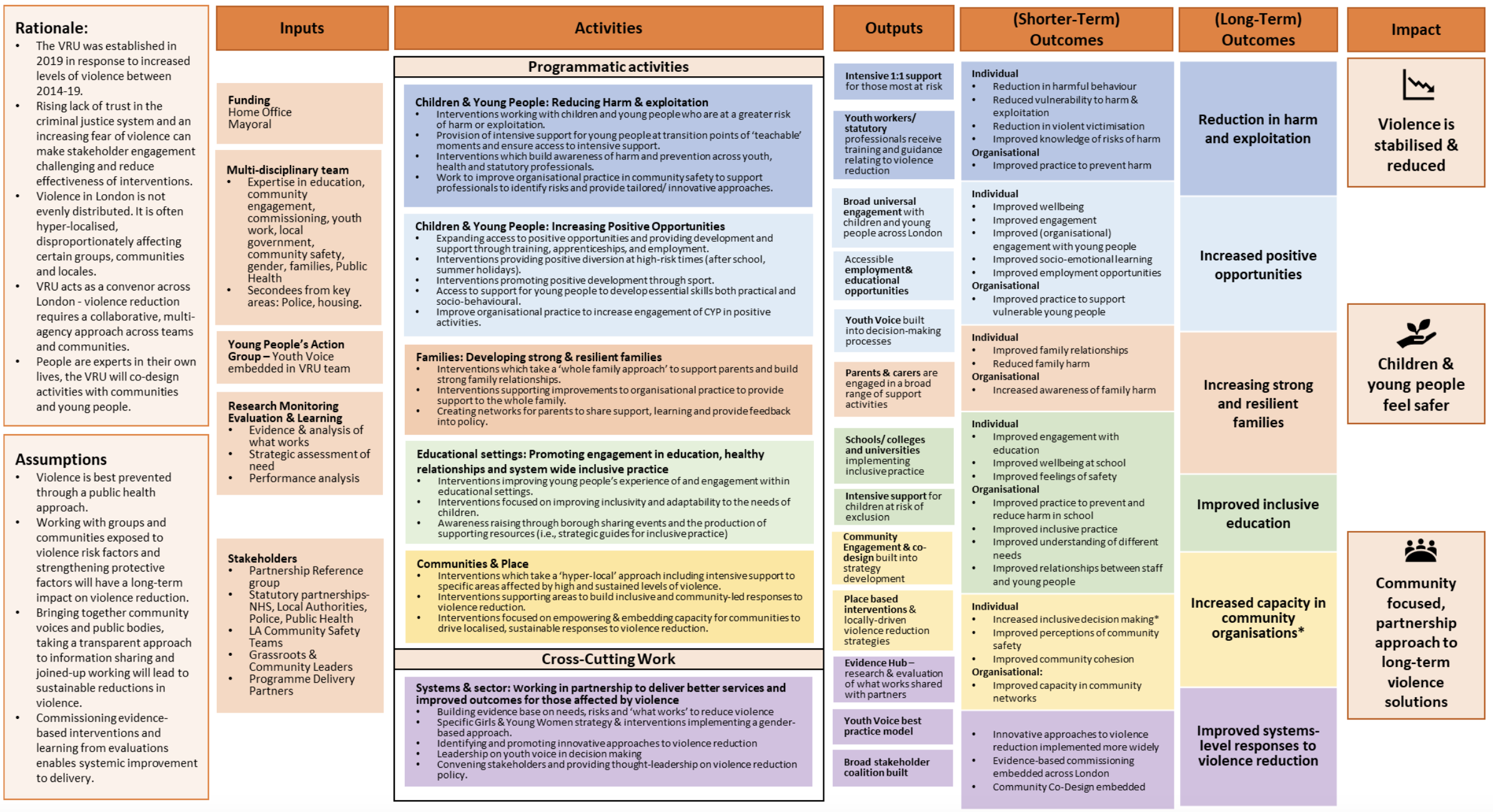
Demonstrating Short-term Progress: An Active Approach to Performance Management
Though the framework provides a theoretical link to our long-term goals, the challenge of sustaining buy-in in the shorter-term remains. We counter this by publishing quarterly performance reports which provide a detailed view of distance travelled across each step of the framework.
Monitoring can often feel reductive. At best, it lacks nuance; at worst creates perverse incentives and drives dangerous behaviours. For this reason, we are moving towards a relational and active contract management approach which encourages mutual learning and focuses on opportunities for systemic change. The work is ever evolving. It takes time to build trust and work through long established power dynamics between Government and community organisations. However, building dialogue and investing in grassroots partners capacity is helping us to create a holistic focus on delivery that is both more efficient and equitable.
Long-term Knowledge Building – the VRU Evidence Hub
As time passes, we build up the ability to understand impact against our long-term goals. To share this learning, we have built the Violence Reduction Evidence Hub which houses independent evaluations across our programmes. Fidelity to well-evidenced models is important, but London is a diverse city, and programmes must be adapted to context. The hub acts as a London-specific evidence base, supporting our partners to adapt ‘what works’ to their local needs. Increasingly we are focused on producing action-oriented outputs -including templates for commissioners, strategic workbooks for leadership, and youth facing reports. Over the last six years we’ve learned that successful implementation requires high-levels of buy-in. Involving stakeholders - particularly young people - can make all the difference. Our Young People’s Action Group and Youth Practitioners Advisory Board are key consultative mechanisms that ensure that our theory and evidence translates to reality.
Staying the course
We are starting to see progress against our ultimate goals. In 2025 year, homicides of under-25s were down more than 50% on the previous year’s 22-year low. We believe that violence is preventable, not inevitable - meaning that there is more work to do. As budgets tighten, partnership working often suffers. Prevention may be easier to cut, precisely because of the difficulties of measurement. More than ever, it is important to continue to make the case for treating violence as a public health issue.